Precision Spray Painting
Precision Spray Painting
Whether it's a single scratched panel, a stone-chipped bumper, a kerbed door edge or a scuffed wing mirror, our precision spray painting service restores the affected area to a flawless, factory-matched finish — without the cost or downtime of a full respray. The key to a genuinely invisible repair isn't the paint itself, it's the preparation, the colour match and the blending technique. Done properly, even an experienced eye can't tell which panel was painted. Every job begins with a free inspection, paint-depth reading and colour assessment so you know exactly what we're working with.
- Free inspection & instant quote
- Computerised colour matching
- Blended invisible panel repair
- 12-month workmanship warranty
What spray painting covers
Our precision spray painting service handles the full range of localised paint repairs — anything short of a full body respray. Common jobs include:
Scratched Panels
Doors, wings, bonnets, boots — anything scratched through the clear coat, spot-refinished and colour-matched.
Stone-Chipped Front Ends
Bumpers and bonnets riddled with small chips get refinished and re-cleared, restoring a clean, uniform surface.
Scuffed Bumpers
Kerb scuffs, car-park scrapes and low-speed impacts — plastic bumper repair or replacement, painted to match.
Scratched Door Edges
Common tight-parking damage — spot-repaired and blended so the edge disappears into the surrounding paint.
Scuffed Mirrors & Trims
Wing mirrors, door handles and small trim pieces refinished to factory colour and gloss.
Panel Repairs After Dents
Dented panels that have been beaten or filled back into shape, then refinished and blended.
Why preparation is everything
When a spray-painted panel fails — lifting, peeling, colour mismatch, or visible paint edges — it's almost never the paint's fault. It's the preparation. Spray painting a car properly involves removing parts you don't want painted, correctly sanding and feathering the area being repaired, treating any rust or corrosion, priming and wet-sanding, applying a sealer to prevent reaction, then finally spraying base coat and clear coat. Skipping any of those steps produces a repair that looks fine for a few weeks and then fails.
We follow every step, every time — even on the smallest spot repair. That discipline is why our paintwork holds up, and why our customers don't see the repair reappear six months later.
Colour matching — how we make it invisible
Modern car paints — especially metallics and pearls — are impossible to match by eye alone. Sun exposure also shifts existing paint over time, meaning the factory colour code is often not quite what's actually on the car. Our matching process:
- Factory paint code identification — the exact colour your car left the factory with.
- Spectrophotometer reading — computerised measurement of your car's actual current paint colour.
- Hand-tint sample panels — we spray test cards and compare them under daylight-balanced lighting until the match is exact.
- Blending into adjacent panels — even a perfect match needs blending to look invisible at panel gaps and angles. We blend into wings, doors or bonnets as needed.
How the process works
Inspection & Colour Assessment
We inspect the damaged panel, measure paint depth to understand what we're working with, and identify the exact factory colour. For older cars with faded paint, we also assess how much the surrounding paint has shifted from original.
Wash & Decontamination
The affected panel and surrounding areas are thoroughly cleaned and decontaminated. Spraying over dust or residue traps it under the paint permanently.
Masking & Disassembly
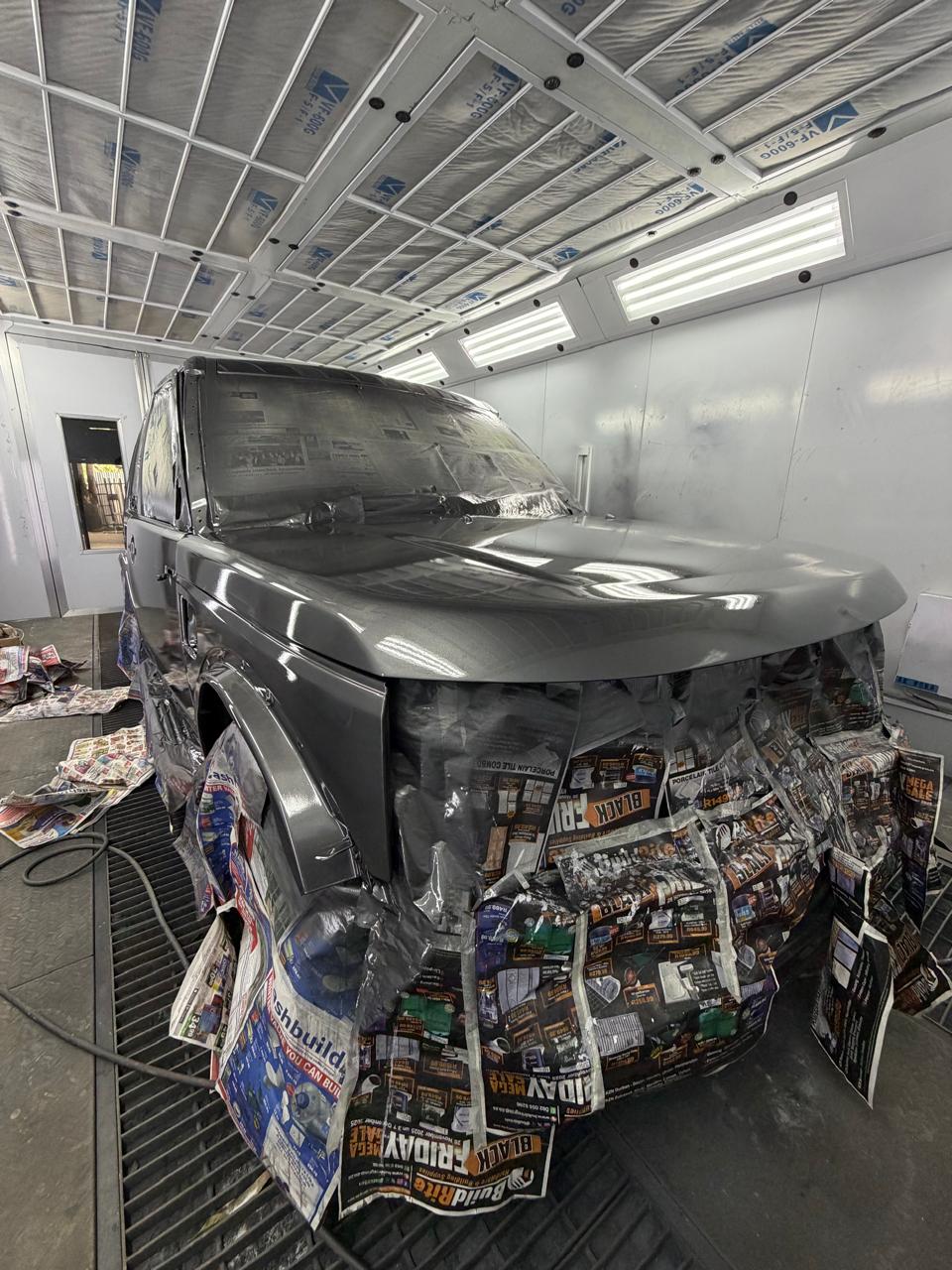
Trim, badges, lights, handles and any parts adjacent to the repair are masked or removed. Where possible we remove parts rather than mask, so no paint lines are visible at edges.
Surface Preparation
The damaged area is sanded, feathered and smoothed. Any rust is treated to bare metal and any dent is beaten or filled. This stage determines the final smoothness — imperfections here show in the finished paint.
Primer & Sealer
Primer is applied and wet-sanded flat, then a sealer coat prevents reaction between old and new paint. Skipping the sealer is one of the main causes of paint bubbling or lifting in cheap repairs.
Base Coat Application
The colour-matched base coat is sprayed in a climate-controlled booth, then blended into adjacent panels. Multiple light coats — not one heavy coat — produce even coverage and correct metallic orientation.
Clear Coat Application
Clear coat is applied to seal in the colour, provide UV and physical protection, and give the repair its gloss and depth. Thin clear coat fails quickly — we don't cut corners here.
Curing, Polishing & Inspection
The paint cures fully, then the panel is machine polished to remove any orange peel or surface imperfection. Final inspection under daylight-balanced lighting from multiple angles. Any slight colour shift is corrected before handover.
Aftercare — protecting your new paintwork
The first 30–90 days after a spray repair are critical. Fresh paint continues to cure and outgas, and it's more vulnerable during this period than paint that's been on the car for years.
- Wait 30 days before waxing or coating — applying a coating too early traps solvents under the paint, which causes clouding or blistering.
- Avoid high-pressure washing for 30 days — gentle hand washing only. New paint is softer and more vulnerable to damage during curing.
- Never use automatic car washes with brushes — good practice permanently, but especially important in the first 90 days.
- Remove bird droppings, insect remains and tree sap promptly — acidic and particularly aggressive against fresh paint.
- After 90 days, apply ceramic coating or PPF if desired — this locks in the finish and protects the entire car, including the repaired panel, against future damage.
- Book a 30-day check-up — free of charge. We inspect for any settling, reactivation, or slight colour shift and rectify if needed.
- Wash every 2 weeks with pH-neutral shampoo — the same discipline you'd apply to the rest of the car.
How long does a spray repair take?
Realistic timelines for common spray painting jobs:
- Single small panel (mirror, door edge): 1–2 days.
- Bumper or wing refinish: 2–4 days (including paint curing).
- Full door or bonnet refinish: 3–5 days.
- Multi-panel blending repair: 4–7 days.
We'll give you a firm timeline at booking. Rushing paint is the fastest way to fail — we'd rather take an extra day than hand back a job we're not proud of.
Why choose DOP RESPRAY & DETAILING for spray painting?
Precision spray painting is a service where the visible result is only a small part of the story. Two repairs can look identical on day one and diverge wildly a year later — one still holding up, the other showing lifting, colour mismatch or paint edges. What separates them is preparation, correct colour matching, proper sealer application and full curing. Our process covers all of these, every time, on every job.
We also carry a 12-month written warranty against workmanship defects — peeling, blistering, adhesion failure. If anything goes wrong, we make it right. That's the standard we hold ourselves to, and it's why customers come back for their next vehicle too.
Frequently asked about precision spray painting
Will the repaired paint match my original colour exactly?
Can you match metallic and pearl paint finishes?
How long will the spray painting last?
Can I respray just one panel, or do I need to do the whole car?
Will the repaired panel look the same shade as the rest of the car?
Can you fix rust before painting?
Can I drive the car immediately after painting?
How much does precision spray painting cost?
Get an instant quote for Precision Spray Painting
Free inspection, colour-matched estimate, and honest advice — ready in under two minutes.